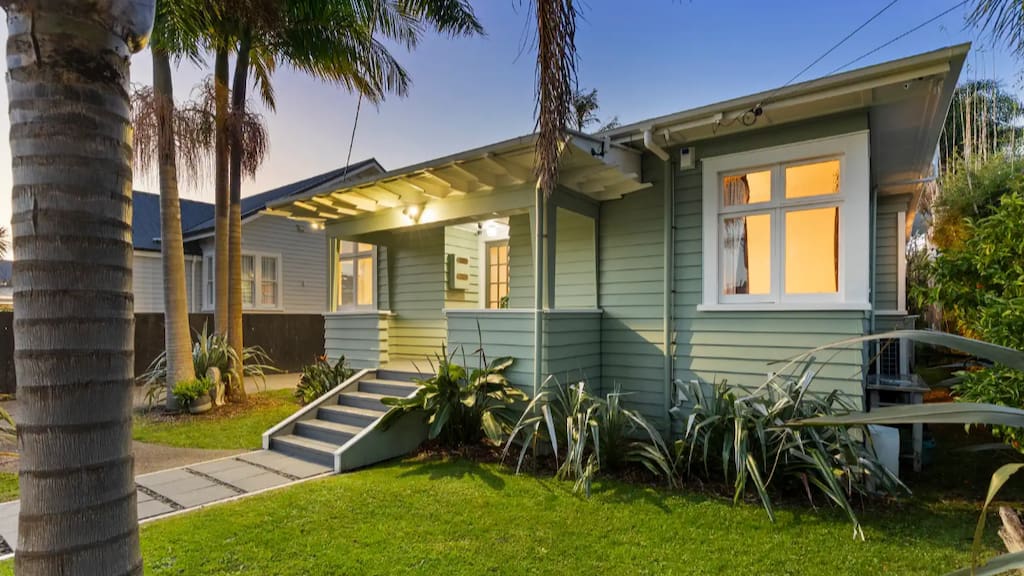
Dame Jacinda Ardern's former Auckland home has become a high-profile Sandringham property story after 1News reported that the house is now on the market and due to go to auction on Wednesday, 8 July. The report says the 1930s bungalow has an estimated sale range on realestate.co.nz of $2.12 million to $2.46 million, while the average sale price for other houses in the suburb is $1.45 million.
The celebrity element is obvious, but the property angle is more useful than simple curiosity. A former prime minister's home coming to market gives readers a visible example of how location, history, school zoning, renovation and public profile can sit inside the same sale. The listing is described in the report as a family-focused, forever home, with the property close to Balmoral School. The Facebook listing reportedly hints at the former owners with the line about stepping inside a former prime minister's Sandringham home.
Ardern and Clarke Gayford moved into the four-bedroom, two-bathroom home in early 2018 after Ardern became prime minister in October 2017. Their daughter Neve was born in June 2018. Since resigning in 2023, Ardern has spent time in the United States through Harvard fellowships and, according to 1News, relocated with her family to Sydney earlier this year. Those biographical details explain why the sale is happening, but they should not obscure the local housing signal.
Sandringham is one of Auckland's inner-suburban markets where character homes, school access and central-city proximity can still command a premium even when the broader market is uneven. A price estimate above $2 million is not surprising for a renovated or well-positioned family home in that area, but the comparison with the suburb's average sale price gives readers a useful benchmark. It suggests the property is being positioned well above the middle of local sales, likely reflecting its size, condition, profile and location.
The auction date also matters. A public auction on 8 July will test whether buyer appetite matches the estimate. High-profile listings can attract attention, but attention does not automatically become a stronger sale price. Buyers still look at borrowing capacity, insurance, building condition, school access, renovation quality and whether the home suits their family. Vendors and agents may hope the public association adds heat, but the market will ultimately measure the property against comparable homes and current mortgage conditions.
For Auckland's wider property market, the story lands at a time when many households are trying to read mixed signals. Some buyers are watching for lower interest-rate pressure, others are cautious about job security and living costs, and vendors are trying to price homes realistically after several years of market adjustment. A well-known Sandringham bungalow will not define the whole market, but it will provide a visible test of demand for premium inner-suburban family homes.
The cleanest way to read the sale is as both a human move and a market marker. A former prime minister's family home carries public interest because of who lived there. It also carries property interest because it asks what Auckland buyers are willing to pay for a central character home with a strong story attached. The auction result, if reported, will say more than the listing estimate does today.