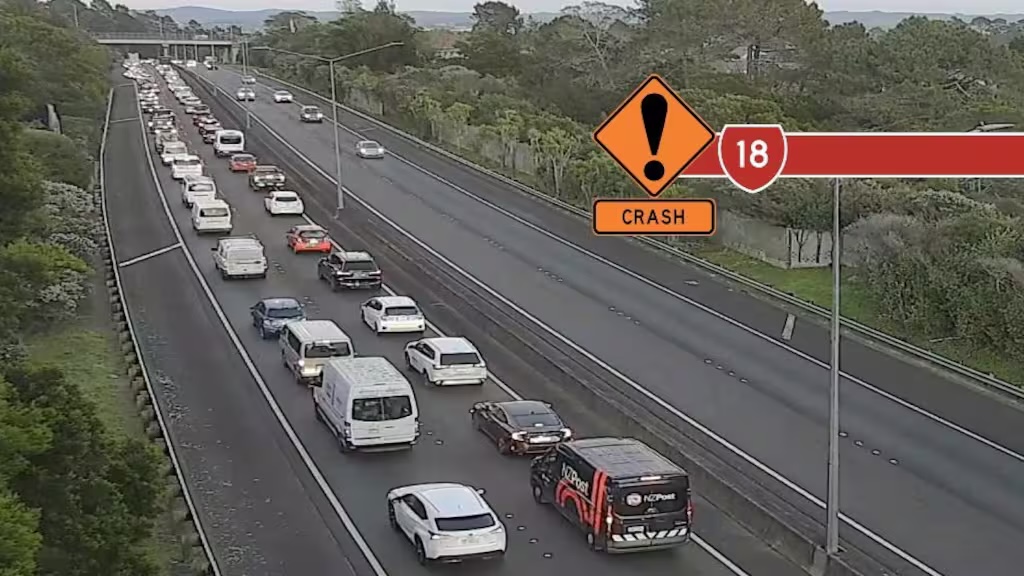
Two crashes on State Highway 18 near the Greenhithe Bridge disrupted Auckland's morning rush hour on Wednesday, with police reporting a three-vehicle crash near the Squadron Drive off-ramp shortly before 7.30am and a secondary crash a short distance back up the hill soon afterwards. 1News reported that the motorway was closed while emergency services cleared the scene, then reopened with delays expected as congestion eased.
One person received moderate injuries, according to the 1News report. The crash location made the disruption especially difficult because the Greenhithe crossing is a key western and northern link. When SH18 slows or closes around the bridge, traffic pressure can quickly spread into Upper Harbour routes, local approaches and connecting motorway corridors.
The incident is a reminder that Auckland's motorway network often has little spare capacity during the peak. A single crash can slow one corridor. A crash followed by a secondary crash can turn a normal commute into a network problem. Secondary crashes are particularly concerning because they often occur when following drivers meet sudden queues, lane changes, rubbernecking or emergency-vehicle activity before they have fully adjusted their speed.
That pattern is why police and transport agencies regularly ask drivers to leave space, merge early and avoid sudden lane changes around crash scenes.
Greenhithe's geography adds to the problem. Drivers using SH18 are often connecting between the North Shore, West Auckland and State Highway 16. Some are heading toward Albany, Hobsonville, Westgate, the Northwestern Motorway or the airport route via the western network. If that link is blocked, there is no simple alternative that absorbs the same volume without delay. Local streets are not designed to take motorway-scale traffic for long.
For commuters, the lesson is practical rather than dramatic. Auckland drivers should treat live traffic information as part of the trip, especially on corridors where a bridge or limited crossing creates a chokepoint. By the time drivers can see the queue, their options are often worse. Checking before leaving can make the difference between delaying a trip, shifting to a different route early or getting trapped in a slow-moving backup.
The crash also shows why emergency clearance matters. Closing a motorway is disruptive, but leaving damaged vehicles, injured people or responders exposed in live lanes is worse. Police, fire, ambulance and road crews need enough room to work, and drivers approaching a scene need to slow down without creating another hazard. That is the trade-off behind closures that can feel excessive to people stuck in traffic.
Auckland's winter conditions make these incidents more likely to bite. Low sun, wet road surfaces, mist, heavier school and work traffic and impatient lane changes all add small risks that become significant when the network is busy. Even where weather is not the direct cause, winter commuting leaves less margin for sudden braking or distraction.
The Wednesday morning incident was cleared, but the wider issue remains. Auckland's motorway system depends on many drivers making safe decisions at speed in places where delays can compound quickly. Greenhithe showed again that a few minutes and a few hundred metres can be enough to turn one crash into a city-wide commute problem.