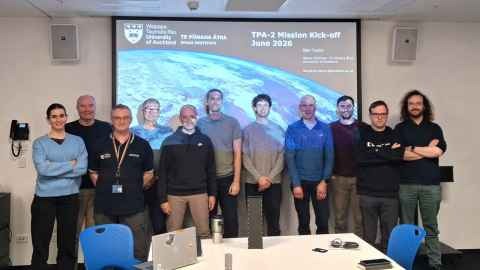
The University of Auckland's Space Institute has started work on TPA-2, a small satellite mission designed to carry six New Zealand-developed payloads into orbit in early 2028. The university said the mission was formally set in motion on 30 June, when payload providers met to begin preparing hardware for flight.
TPA-2 is named for Te Pūnaha Ātea, the Space Institute, and is being described by mission lead Dr Ben Taylor as a kind of space shuttlebus. The point is to give emerging companies, researchers and education groups a route to orbit without each having to build or buy an entire spacecraft mission of their own. For a country trying to grow a deeper space sector, that shared-platform model matters.
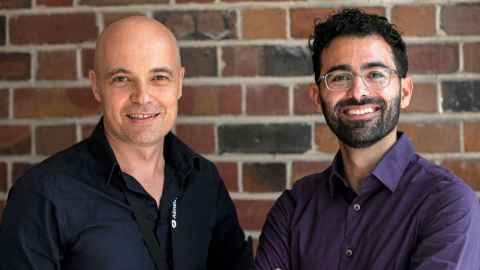
The university says the mission will carry six curated payloads from industry, academia and education. One is Lune Digital's modular maritime-domain-awareness payload, led by Stephen Fellner and Paul Mallinson. The device is smaller than a can of Coke and is intended to capture ocean imagery, use onboard artificial intelligence to flag areas of interest, and send only relevant data back to Earth. The university describes the Auckland-based team as working toward world-class optical sensing capability.
Other payloads widen the mission beyond one commercial use case. The list includes a schools education payload, a University of Auckland thermal imaging project, student and research technology, and payloads intended to test capability that can support future missions. The common thread is flight heritage. Space hardware companies and researchers often need proof that their technology can survive and operate in orbit before customers or partners will trust it.
That is why the phrase shuttlebus is useful. A small satellite that carries several local technologies can lower the barrier between a promising lab or prototype and a space-tested system. It does not remove technical risk, but it can make the path more structured. The mission also received $283,827 in round one of the Kiwi Space Activator pilot programme, with Taylor saying the support is being channelled into flight opportunities for other groups.
For Auckland, the story is both educational and economic. The city already has universities, engineering talent, software capability and start-up networks that can feed into the space sector. A mission like TPA-2 gives those groups a practical anchor. It tells students and early-stage teams that space work is not only a distant industry dominated by large overseas primes. It can involve small sensors, onboard AI, communications, environmental monitoring and school-level science pathways.
The maritime monitoring angle also connects New Zealand's geography to the business case. New Zealand oversees a vast ocean area compared with its landmass. Tools that can observe maritime activity, environmental conditions or remote areas from orbit may have uses for fisheries, conservation, security, search and rescue, and climate research. The next 18 months will test whether the project can keep payload teams aligned, move from meeting-room commitment to flight-ready hardware, and hold its early-2028 target.
The programme also gives Auckland a way to link public research with private capability. Universities can convene technical teams, manage mission discipline and expose students to real delivery timelines, while companies can test components that may later become commercial services. That combination is valuable because space businesses do not grow on software alone. They need hardware discipline, regulatory awareness, customer use cases and evidence from orbit. TPA-2 is small, but it gives those pieces a shared deadline.