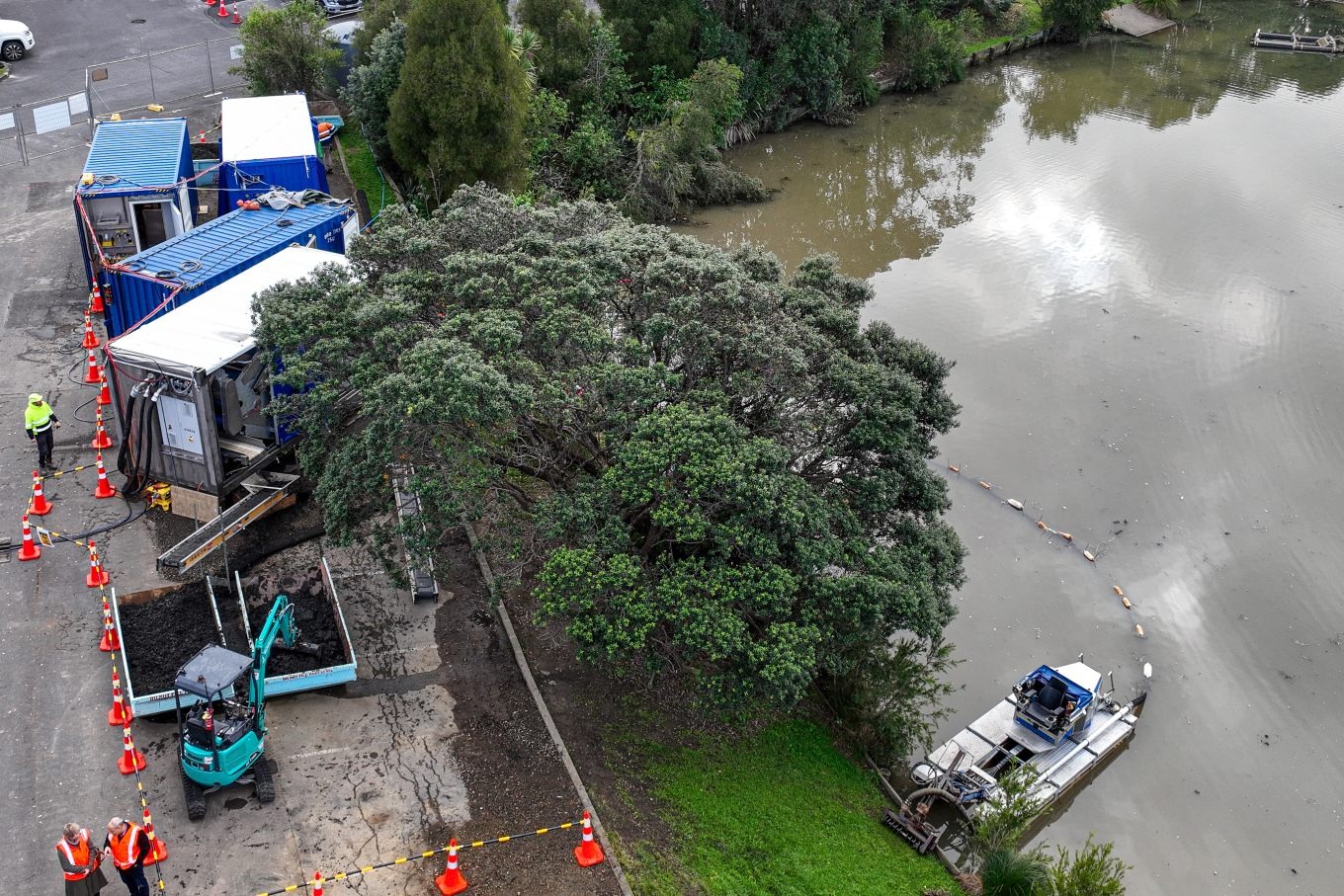
Auckland Council is testing Swiss-engineered dredging technology on the North Shore in a trial aimed at cutting the amount of stormwater sediment sent to landfill and reducing the truck movements needed to manage it. The mobile dewatering plant is being used at Wairau Pond in Wairau Valley, where council stormwater teams are looking for a cleaner way to remove and process the material that collects in the city's treatment ponds.
The basic problem is simple but large. Stormwater ponds trap sediment and contaminants before they reach streams, estuaries and harbours. That protects waterways, but only if the ponds keep enough capacity to do their job. When sediment builds up, it has to be removed. OurAuckland says about 14,000 cubic metres of sediment was taken out of Auckland stormwater ponds last year, and around 2.2 million cubic metres is expected to be removed over the next 20 years.
Traditional removal methods can create their own environmental problem. Wet sediment is heavy, bulky and expensive to haul. If it is dug out and trucked away largely as mixed waste, Auckland gets cleaner ponds but also more landfill pressure and more transport emissions. The Wairau trial is designed to change that equation by processing the sediment on site.
The Swiss plant separates water, sand, gravel, stone and silt in a single mobile operation. Council says that could reduce the volume of material going to landfill by up to 60 percent. The separated sand and gravel may be reusable as fill or aggregate, while silt may be reused on site for topsoil and planting. If the method works at scale, it would turn part of a disposal problem into a recovery process.
The local importance is bigger than one pond. Auckland's stormwater system sits under growing pressure from urban development, heavier rainfall events and the public expectation that beaches and harbours should be protected from polluted runoff. Sediment is not just dirt. It can carry metals, hydrocarbons and other contaminants from roads, roofs and car parks into streams if treatment systems are not maintained.
Wairau Valley is a useful test site because it is an urban catchment with commercial, industrial and residential runoff pressures. A method that works there could help council make better decisions for other ponds across the region. The trial also fits a wider infrastructure question: Auckland needs maintenance systems that are not only effective, but also less wasteful and easier to scale.
Residents may not notice a mobile dredging plant in the same way they notice roadworks or a new station. But this is the kind of unglamorous work that decides whether environmental promises hold up. Harbour quality depends on routine infrastructure being maintained before problems become visible. A smarter sediment process will not fix every stormwater issue, but it could make one necessary job cleaner, cheaper and more circular. The trial should now be judged on practical evidence: how much waste is avoided, what reuse options are realistic, how the costs compare with existing methods, and whether the technology can be deployed across different pond types.