
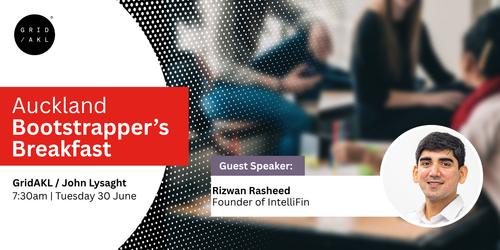
Auckland founders have a practical business date on the calendar as GridAKL prepares to host the June Auckland Bootstrapper's Breakfast at Wynyard Quarter on Tuesday 30 June. The Humanitix listing says the session is titled "How Startups Run Out of Money (and How to Make Sure Yours Doesn't)" and is designed for early-stage founders, entrepreneurs, bootstrappers and people still validating an idea. It will run from 7.30am to 8.30am at the GridAKL Startup Hub, John Lysaght coworking space, 101 Pakenham Street West.
The founder focus is explicit. The listing says the session will unpack the financial realities of building a startup and explore practical ways founders can improve financial decision-making from day one. Topics include why startups run out of money, how to understand and extend runway, controlling monthly burn, why margin can matter more than revenue, early thinking about customer acquisition cost, cash-flow management, common financial mistakes and a simple decision framework for founders.
The speaker is Rizwan Rasheed, described in the listing as a Chartered Accountant with Big Four training, founder of his own accounting and advisory practice, and founder of IntelliFin, a continuous financial intelligence platform designed to help businesses understand their numbers and make faster, better decisions. That combination gives the event more weight than a generic networking breakfast. It is not only telling founders to be careful with money; it is being fronted by someone who works at the intersection of accounting advice and startup building.
For Auckland's startup community, the timing matters. The funding climate is still selective, operating costs remain high, and many small companies are having to prove traction before they can count on outside capital. A founder who understands cash runway early is less likely to confuse activity with durability. Revenue can look encouraging while margins are thin, customer acquisition is expensive and the bank balance is narrowing. That is often where young companies get into trouble.
GridAKL is also a relevant venue. Wynyard Quarter has become one of the city's better-known startup and innovation locations, close to corporate offices, investors, professional advisers and waterfront hospitality. A breakfast format makes the session accessible to working founders who may not be able to lose a whole day to training. The listing says coffee, light breakfast and networking are included, with registration required even though the event is free.
The most useful part of the event may be the language. Founders are often pushed toward growth stories, pitch decks and product launches. Those are visible, but finance is where many early companies fail quietly. If the session gives operators a clearer grasp of burn rate, margin, cash conversion and when to stop spending on weak assumptions, it could help companies avoid mistakes that are harder to repair later.
This is why the event belongs in today's Auckland business pack. It is small compared with a funding announcement, but it is closer to the everyday reality of founder-led companies. A city that wants stronger startups needs more than celebratory demo days. It needs founders who know how long their money will last, what each customer costs, which expenses are essential and when a business model is not yet proven. Auckland's next durable company may depend on that discipline before it depends on a headline investment round.