
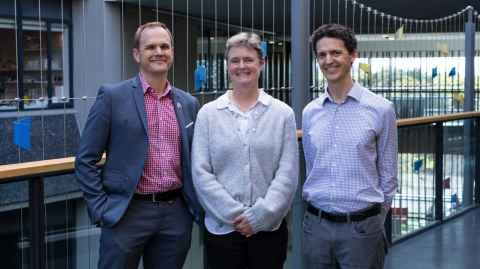
Auckland's cancer research system has a new leadership layer, with the University of Auckland naming three associate heads for its new Department of Cancer Sciences.
The appointments matter because the department is designed to connect work that can too easily sit in separate lanes: laboratory research, clinical trials, oncology teaching and the experience of patients moving through care.
Associate Professor Julie Spicer will serve as Associate Head Research, Associate Professor Stephen Jamieson as Associate Head Academic, and Dr Laird Cameron as Associate Head Clinical. The University says the new department brings together the Auckland Cancer Society Research Centre, the Department of Oncology, Cancer Trials New Zealand and Te Aka Mātauranga Matepukupuku Centre for Cancer Research.
That structure gives Auckland a clearer platform for translational cancer work. Spicer, a medicinal chemist and former Auckland Cancer Society Research Centre director, has pointed to the value of putting different research disciplines inside the same department. Jamieson, a cancer pharmacologist, will look at teaching and postgraduate supervision across cancer-related study. Cameron, a thoracic medical oncologist and clinician-scientist at Te Pūriri o Te Ora Auckland Hospital, is placing patient perspective at the centre of the work.
For Aucklanders, the useful test is not the title change itself. It is whether research ideas, clinical problems and teaching pipelines can move faster because people are closer together. Cancer care depends on evidence, workforce development, trials access, patient voice and the ability to turn discoveries into treatment pathways.
The University is framing the department as a step toward stronger national cancer capability. That is ambitious, but the local logic is straightforward: Auckland already has researchers, clinicians, students and patients working around the same problem. Better connections between them could make the work less fragmented.
If the new team can make those connections practical, the department will be more than a reshuffle. It will be a bridge between discovery and care at a time when patients need both.