
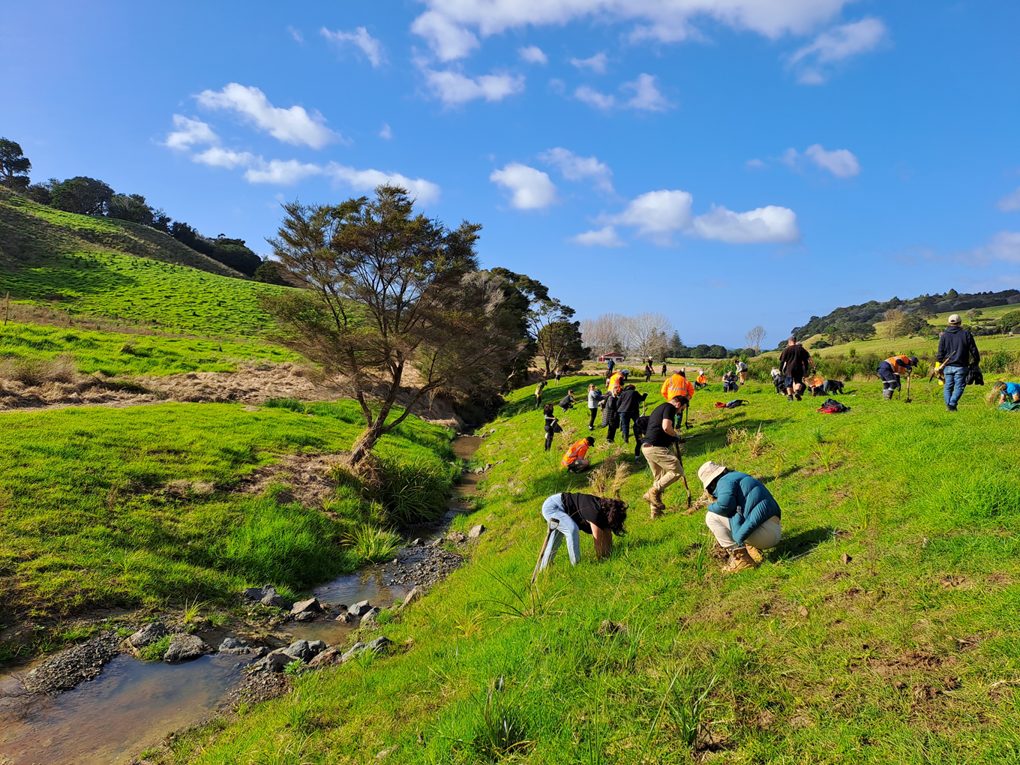
Auckland Council says six years of Mahurangi Land Restoration Programme monitoring has produced clear evidence that fenced and planted waterways are carrying less fine sediment than comparable open-pasture streams. The 28 July update says restored streams recorded more than a 30 percent reduction in fine sediment, a result that gives Auckland a measurable environmental story rather than only a general call for planting days and goodwill.
The monitoring period ran from 2023 to 2025 and compared streams flowing through open pasture with fenced and planted waterways and streams flowing through native forest. Council says the restored streams also showed better habitat and fewer harmful mobile mud particles, which were twice as common in unrestored waterways. Higher numbers of pollution-sensitive insects were also recorded in restored streams, a sign that ecological health is improving rather than merely looking greener from the bank.
The programme was delivered by Auckland Council and funded by the Ministry for the Environment in partnership with Ngati Manuhiri Settlement Trust between 2020 and 2026. It built on the Mahurangi Action Plan and focused on reducing sediment entering waterways from rural land use, unsealed roads and development activity. That mix matters because the problem is not one source. Sediment can come from farms, roads, earthworks and exposed banks, and it does not stay neatly where it starts. It moves through streams toward the harbour and affects habitats beyond the first muddy channel.
Councillor Richard Hills, chair of Auckland Council's Policy, Planning and Development Committee, framed the result as a collaboration between local and central government, iwi, landowners, volunteers and community groups. The detail behind that is important for readers because environmental restoration can fail when responsibility is pushed onto one group. Landowners need practical support, councils need monitoring, community groups need continuity, and funders need evidence that the work is producing more than a photo opportunity.
Programme manager Colleen Brent said the monitoring shows fencing and planting stream margins makes a difference, while also reminding people that restoration takes time. That is the plain lesson from the Mahurangi update. A planted edge is not an instant fix; it needs years of growth, weed control, stock exclusion, maintenance and measurement before it can show whether the investment is working. The council says the funded portion of the $6.15 million programme has now concluded, but landowners can still seek practical advice and co-funding through the Rural Waterway Protection Fund, with the next round opening in September.
For Auckland, the value of the result is both local and regional. Mahurangi is a specific catchment with its own harbour pressures, but the same arguments apply to other rural and peri-urban waterways. If monitoring can show sediment reductions after sustained work, future restoration debates can move from belief to evidence. The next test is whether the programme's momentum survives after the initial funding phase, because stream health is won over decades, not during a single grant cycle.
That is also why the September funding round is worth watching. If more landowners use it, the Mahurangi result can become a template for practical catchment repair rather than a one-off success story.