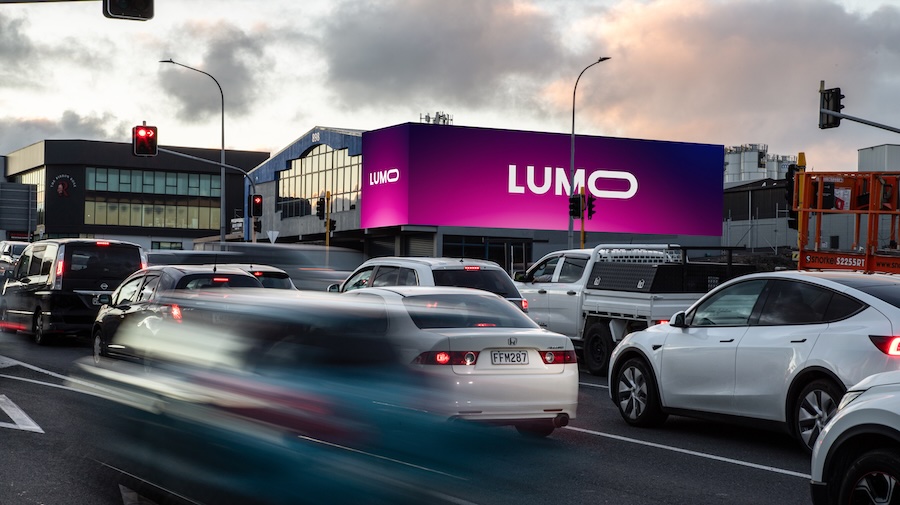
LUMO Digital Outdoor is putting Penrose into the national advertising conversation with a new roadside screen that it says will be Aotearoa's largest landscape digital billboard when it goes live on 2 November. The company has announced LUMO-Great Southern Lights for the corner of 898 Great South Road, a position that gives the site a view across one of Auckland's busiest commercial and commuter corridors. For agencies and brands, the practical point is scale. For Aucklanders, the more visible point will be a large new digital landmark on a route linking the city, the airport, Sylvia Park, Ikea, Mt Smart Stadium and surrounding industrial precincts.
The founder-focused part of the story sits with LUMO co-founder and chief executive Phil Clemas, who told NZ Marketing that the site reflects advertiser demand for premium digital out-of-home media that combines location with stronger creative impact. LUMO is describing the screen as a rare mix of scale, visibility and dwell time, with the corner return designed so it can be seen from all four intersections. Those details matter because outdoor advertising has moved well beyond static roadside posters. The business case now depends on format, traffic flow, visibility windows and whether creative teams can build work that reads quickly without becoming visual clutter.
The published site measurements are substantial: 26.4 metres wide, six metres high and about 158 square metres of roadside digital presence. NZ Marketing reported that the format is more than four times the size of LUMO's 12 metre by three metre hero landscape billboard. The site is also being pitched as reaching more than 95,000 people each week and delivering 2.2 million impressions, using knOOH Reach and Impressions reporting for adults aged 18 and over in 2026. Those numbers are advertiser-facing rather than civic planning data, but they explain why Penrose is being treated as a premium audience location.
For Auckland's business community, the announcement lands at the intersection of media, transport and property. Penrose is not a decorative backdrop; it is a working route used by freight vehicles, trades, airport traffic, stadium visitors and daily commuters. A screen of this size will be most valuable if it can serve national brands while still respecting the rhythm of a practical arterial road. That is why agencies will watch not only how many impressions the site promises, but how legible and restrained creative remains in real conditions.
The timing gives advertisers several months to plan inaugural campaigns before the November launch. LUMO says it is already in discussions with agencies and brands, with limited early access availability. The stronger Auckland angle is that a founder-led local media company is trying to make outdoor advertising feel more cinematic without moving it out of the ordinary city commute. If the site performs as promoted, Great South Road will become a test case for how much large-format digital media Auckland's working corridors can carry.
The story is also a reminder that the city's commercial identity is often shaped outside the CBD. Penrose sits between industrial Auckland, retail Auckland and event Auckland, which gives the billboard a broader audience than a conventional central-city placement. That breadth is the opportunity for LUMO and for advertisers, but it also sets the creative bar high. On a fast, busy road, the best work will need to be simple, useful and unmistakably designed for the place rather than squeezed onto it.