
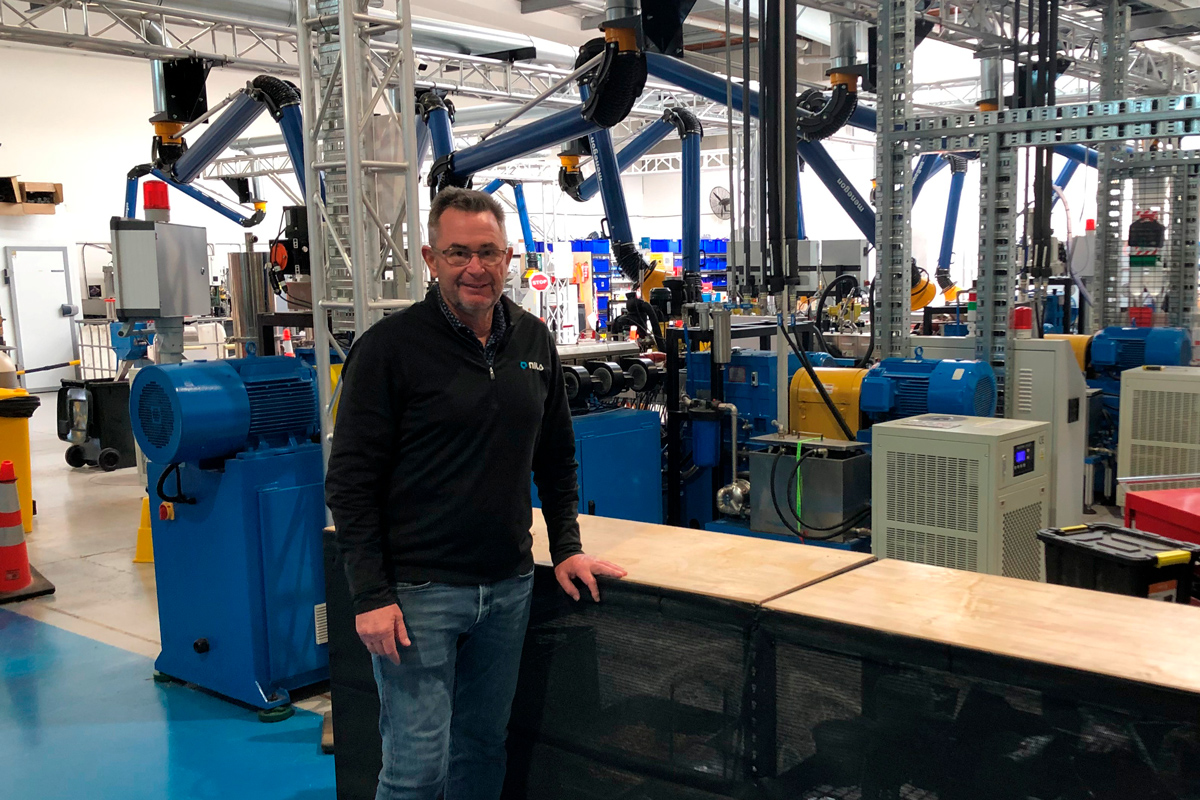
Auckland's North Shore has a founder-led cleantech story in front of business readers today, with NZ Entrepreneur publishing a new profile of NILO and chief executive Mike Maunsell on 24 July. The company is working on industrial adhesives made from plastic waste, aiming at the large manufactured wood panel market where traditional urea formaldehyde products still dominate. That makes the story bigger than a single startup profile. It is about whether an Auckland deep-tech team can turn a waste problem into a manufacturing input that global customers will actually use.
The current profile says NILO's path accelerated after Maunsell was introduced in 2019 to co-founders Tim Williams and Neville Jones. Maunsell had a background in large infrastructure and joined first as chief operating officer before becoming chief executive. NILO's official site separately says its vision is to build a future where plastic waste becomes a valuable resource for safer, commercially viable circular systems. Put together, the two sources show a company trying to move from laboratory promise to a product with industrial discipline.
The market focus is practical. NILO is targeting binders for particle board, medium-density fibreboard and related engineered wood products. These are not glamorous consumer goods, but they are exactly the kind of high-volume materials where a cleaner adhesive could matter. If an alternative can match incumbent performance, cost and integration requirements, it can affect factories, construction materials, emissions, supply chains and waste streams at the same time. If it cannot, it remains a good idea without scale.
That performance question is why the article's commercial detail matters. NZ Entrepreneur reports that recent independent testing in Dresden showed NILO's adhesive could match traditional incumbents. It also says the company is preparing memorandums of understanding for two commercial production facilities, one in New Zealand and one in Australia. Those are still steps toward commercialisation, not proof that a global rollout is complete. But they are stronger signals than a concept pitch because they point toward plant-level execution.
NILO's own website adds important context about partners. It lists Inter IKEA Group among the company's partners and says the relationship began as a collaboration and investment partnership. It also lists investors and supporters including Icehouse Ventures, Clare, SDG Impact Japan, K1W1 and Pacific Channel. For Auckland readers, that matters because deep tech is expensive, slow and partnership-heavy. A startup making physical materials needs more than software velocity; it needs trials, validation, manufacturing links, patient capital and customers prepared to test new inputs.
The founder angle is also useful because Maunsell is not presenting sustainability as a premium-brand accessory. The NZ Entrepreneur profile quotes him saying green sympathy alone is not enough and that true scale requires price, performance and environmental benefit to work together. That is the hard test for Auckland cleantech companies. A product can be environmentally attractive and still fail if it asks manufacturers to absorb too much risk or cost.
For Auckland's business community, NILO is a reminder that the city's startup scene is not limited to apps, software platforms and investor events. There is also company-building in materials, chemistry, manufacturing and circular economy infrastructure. Those ventures can take longer to explain, but they may be closer to the physical systems cities depend on: construction, waste, factories, transport and procurement.
The next year will show whether NILO can convert validation, partnerships and international interest into commercial facilities. For now, the current profile gives Auckland a credible founder-led business story: a North Shore team trying to make plastic waste useful, not by asking people to feel better about recycling, but by building an industrial input that can compete inside real factories.