Auckland's housing debate has a fresh number attached to it: around 38,000 additional homes over the next decade if proposed planning rule changes are adopted.
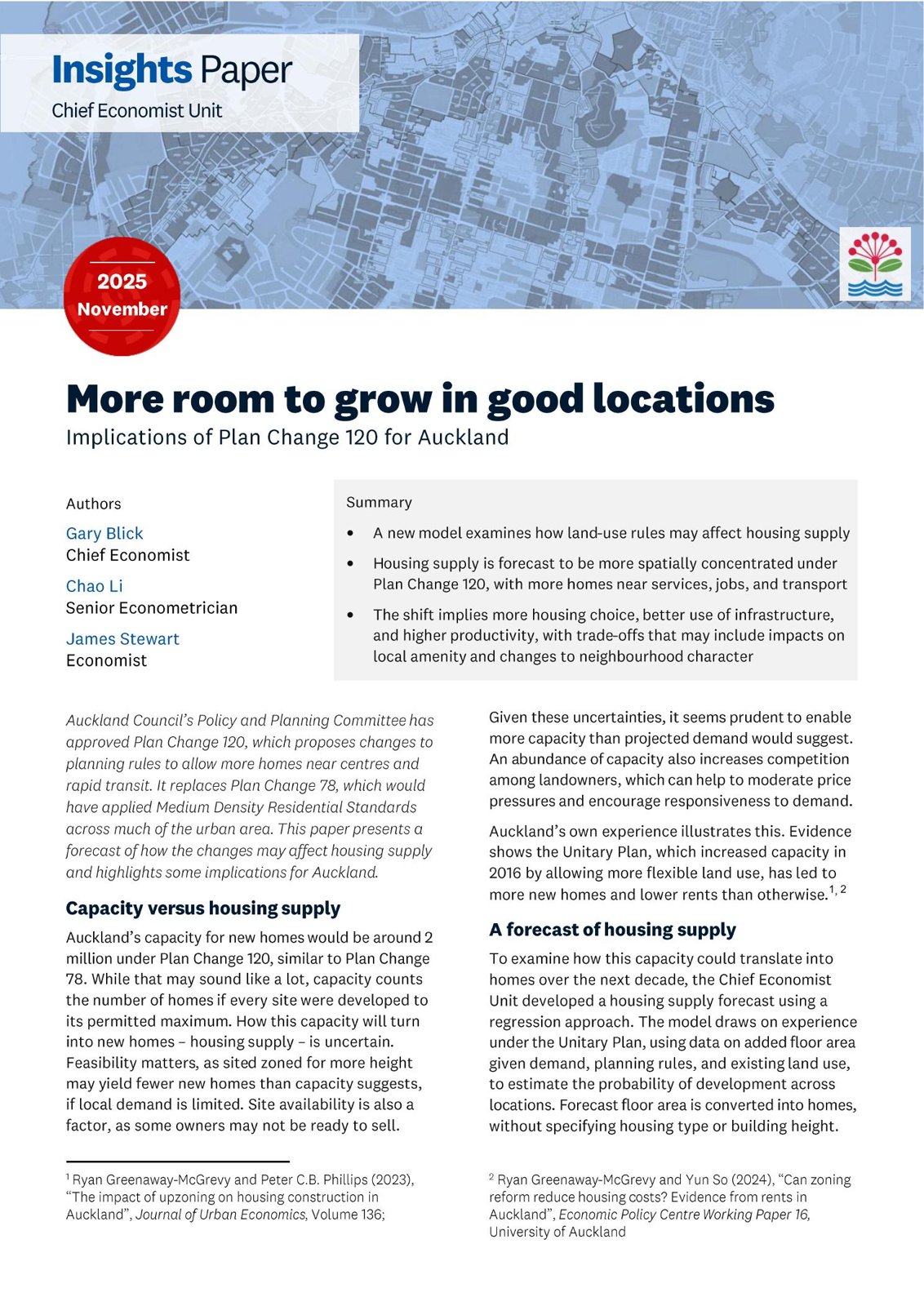
The estimate comes from Auckland Council's Chief Economist Unit, which used the Auckland Housing Supply Model to test revised Plan Change 120 settings against the current Auckland Unitary Plan. The modelling forecasts a roughly 36 percent lift in housing supply compared with the operative plan.
The geography is the important part. The revised proposal focuses more housing capacity in places with good access to jobs, services and public transport, including around the city centre, metropolitan and town centres, rapid transit stations and frequent transit routes within 10 kilometres of the city centre.
That makes this more than a raw dwelling-count story. Auckland has spent years arguing about whether growth should be spread thinly, pushed to the edge, concentrated around transport, or limited in areas exposed to natural hazards. The new modelling is a claim that more homes can be enabled in accessible locations while making better use of existing and planned infrastructure.
The council analysis also estimates 14,300 new homes a year under the revised proposal, compared with 10,500 a year under current planning settings. It suggests house prices could be 3 to 5 percent lower than they otherwise would be, and that regional GDP could be 0.2 to 0.5 percent higher after 10 years.
Those numbers should be treated as modelling, not a guarantee. Developers still respond to finance, construction costs, demand, infrastructure timing, consenting risk and market confidence. A zoning pathway does not automatically produce a built home.
But modelling still matters because it shifts the debate from theoretical capacity to likely outcomes. Aucklanders are being asked to consider whether more homes in connected locations can ease pressure without repeating the mistakes of growth that arrives before transport, water, parks and community services.
The next stage is the Independent Hearings Panel hearing public submissions. That means the decision is not only technical. It is also a test of how Auckland balances housing need, neighbourhood change, infrastructure cost and the daily reality of where people can afford to live.